Build Once. Deploy Everywhere.
Enterprise environments demand seamless interoperability across diverse vendors and platforms. While most systems can connect, the processes they use can become brittle over time. Operating centers, field users and intelligent software layers all depend on timely data moving across systems. Organizations need solutions that reliably normalize, isolate, and automate processes but few platforms effectively deliver this consistency at scale.
Integrators face obstacles such as API updates breaking custom integrations, irreplaceable legacy equipment, rapidly changing cloud services, and siloed systems. Teldio Fabric addresses these challenges directly: its layered module architecture unifies video management (such as Avigilon Unity and Alta), access control, alarm management, industrial systems, and mission-critical communications. This creates a resilient, automation-ready integration platform that streamlines security and operations.
The Multi-Vendor Reality: Complexity Is the New Normal
Modern facilities don’t usually rely on a single infrastructure model. It is common to see on-site video and access control systems working side by side with cloud-based services while IoT devices feed information into larger enterprise environments. Industrial PLCs (programmable logic controllers) and building management systems share data alongside integrated video surveillance and dispatch platforms. Even carefully planned environments inevitably become more diverse over time as acquisitions, phased upgrades, cloud migrations, and vendor changes introduce new systems that must operate alongside older infrastructure rather than replace it outright.
Cascading integration risk is inevitable in multi-vendor environments. One firmware update from a single vendor can quickly disrupt authentication workflows. An API change might interrupt event flow. All these and many other issues can create long-term technical debt with custom middleware solutions. These are costly to maintain and difficult to scale. At the same time, siloed integrations limit data visibility, creating operational blind spots that undermine response. The challenge is no longer simply connecting systems, but to ensure they remain interoperable, stable and aligned as components evolve independently.
Compatibility Not Just Connectivity
Many integration platforms rely on point-to-point integrations, custom scripts and one-off connectors. Some use shallow API polling to connect systems. These approaches may work in the short term, but are fragile in the long term. As vendors update firmware, change authentication methods or update APIs, these tightly coupled integrations become fragile. They require constant maintenance and reactive fixes. Over time, what began as a quick strategy can become complex technical debt. This undermines scalability and reliability.
Teldio Fabric takes a different approach. It uses structured modules, data normalization, deterministic logic and isolation from vendor changes. Built-in automation layers use compatibility as an architectural discipline not a temporary connection. The layers in this design ensure integrations stay resilient as external systems evolve.
The Four-Layer Compatibility Model Inside Teldio Fabric
I. Vendor-Approved Modules: The Pinnacle of Reliability
The highest degree of integration rigor in Teldio Fabric is represented by Vendor-Approved Modules. Deep compatibility and long-term stability are ensured by developing these modules in partnership with key manufacturers.
For deployments using Motorola Avigilon systems, this is very important. Alarm management, access control entry, dispatch video, and two-way radio Motorola operations must all be smoothly integrated with video surveillance monitoring systems.
Vendor-Approved Modules include integrations with popular platforms such as:
-
- Avigilon (Motorola Solutions video platform)
- Honeywell Pro-Watch
- Gallagher
- Avtec dispatch
- And more modules are being added all the time.
These integrations are designed to deliver secure authentication aligned with vendor requirements, strong performance for real-time event processing, consistent data normalization, reliable diagnostics and greater resilience.
In Avigilon deployments, this allows events from integrated video surveillance systems to move reliably into Teldio Fabric’s Behavior Engine. Coordinated actions like targeted radio notifications, automated lockdown workflows or dispatch escalation can start from motion activity, access-related events or analytics-generated alerts.
II. Integration Modules: Expanding the Ecosystem
Not every vendor offers formal certification programs. Teldio Fabric’s Integration Modules follow the same SDK model and architectural rigor as Vendor-Approved Modules but support vendors without formal certification.
This enables compatibility with niche, regional, or specialized systems while maintaining:
- Feature parity with certified modules
- Consistent data normalization
- Unified administration experience
Integrators gain ecosystem flexibility, operating truly vendor-agnostic deployments without loss of control. This enables the delivery of unified, scalable security solutions tailored to each enterprise’s unique needs.
III. Protocol Modules: Universal Compatibility Across Generations
Teldio Fabric supports standardized communication languages that transcend vendor branding. This is where Fabric’s universality becomes clear.
Supported protocols include MQTT, OPC UA, CIP/Ethernet-IP, SMTP, SNMP, REST, SOAP APIs, TCP/UDP, Syslog, and other common standards. By prioritizing these protocols, Teldio Fabric ensures broad compatibility. It works with legacy devices, industrial controllers, modern IoT systems, and cloud platforms, without being tied to any vendor.
Protocol abstraction enables Teldio Fabric to connect:
- Legacy PLCs and industrial controllers
- Modern IoT sensors
- Cloud-based monitoring platforms
- Building automation systems
- Industrial alarm systems
In environments that combine Motorola Solutions video, industrial automation and IoT device monitoring, protocol modules seamlessly bridge operational technology and enterprise IT.
IV. Utility & Core Modules: Turning Security Integration Into Automation
Integration without intelligence is just connectivity.
Teldio Fabric’s Utility & Core Modules transform connectivity into automation. Core capabilities include:
- Scheduled Tasks
- Messaging Enrichment
- Periodic Timers
- Data Archiving & Reporting
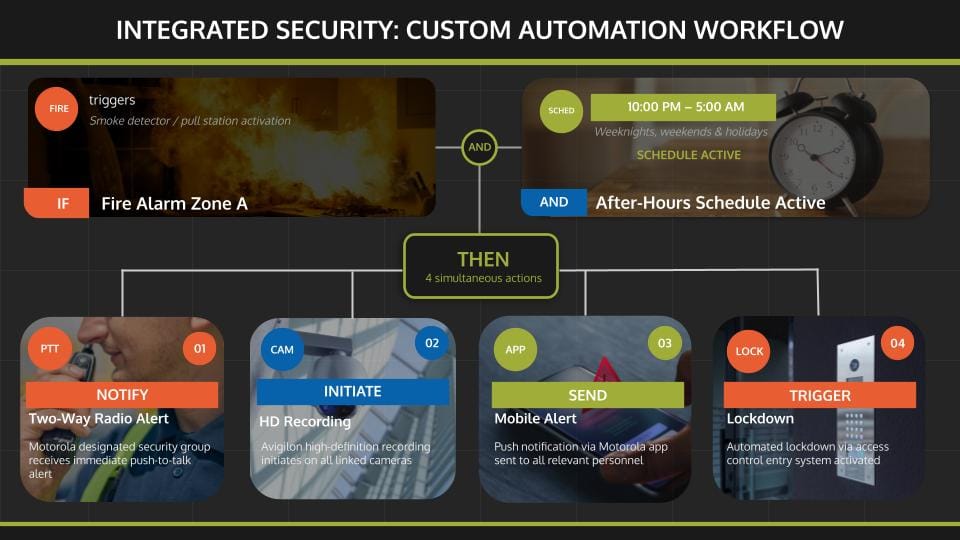
Consider a practical Avigilon use case:
IF Fire Alarm Zone A triggers
AND the after-hours schedule is active
THEN notify the designated two-way radio Motorola group
AND initiate Avigilon high-definition recording
AND send mobile alert via Motorola notifications app
AND trigger automated lockdown through the access control entry system
This is the core value of Teldio Fabric: coordinated, reliable automation across all communications and security systems, delivering a unified response with maximum efficiency.
The result:
- Reduced manual intervention
- Predictable response behavior
- Faster escalation
- Operational efficiency
Automation-readiness transforms integration from basic connectivity to a platform for ongoing value creation, driving new revenue opportunities and operational gains.
Data Normalization: The Hidden Advantage
Every vendor exposes data differently:
- Different data structures
- Different naming conventions
- Different severity mappings
Without robust data normalization, cross-system automation risks errors and missed responses, undermining operational reliability and security ROI.
Teldio Fabric normalizes all events into a unified data model. This creates consistent severity logic and predictable automation. As a result, cross-system automation remains reliable across:
- Avigilon VMS + access control entry coordination
- Fire panel + dispatch radio workflows
- PLC events + building automation responses
- IoT integration with enterprise systems
Normalization eliminates confusion, ensuring all systems work as one, including integrated video, alarms, and communications, for seamless, secure enterprise operations.
Decoupled Architecture: Protection From Vendor Volatility
Integration risk increases as vendor ecosystems evolve:
- API changes
- Firmware updates
- Authentication shifts
- Cloud migrations
Decoupled architecture means integrations stay resilient and automation stays intact, even as vendor technologies shift. Teldio Fabric protects your investment by safeguarding operations, no matter how ecosystems change.
Real-World Integration Categories: Ecosystem Depth
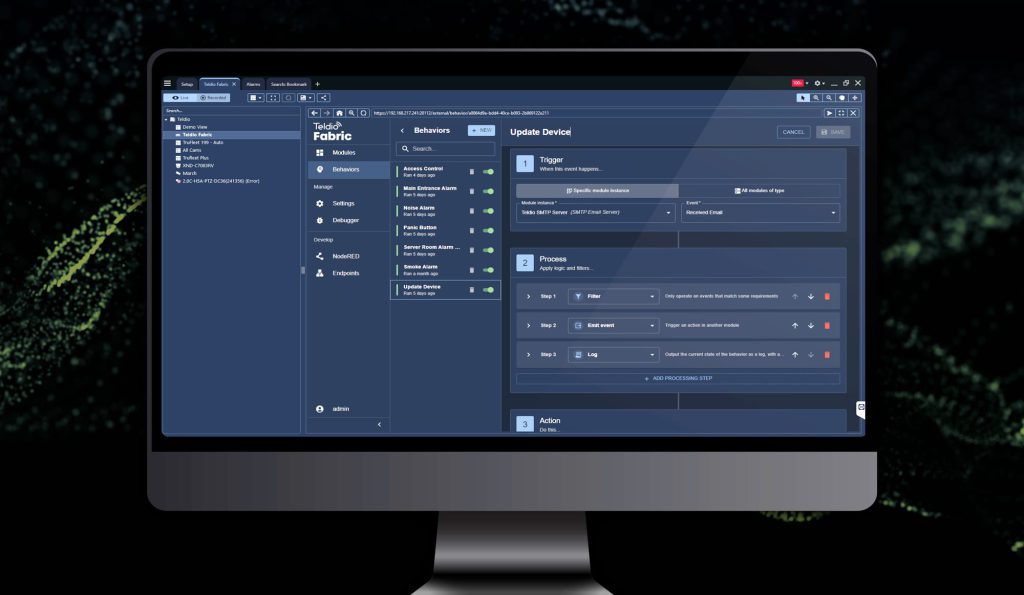
Teldio Fabric integrates across a broad operational ecosystem:
- Video Management Systems: Avigilon Unity and Alta (and more)
- Access Control: Honeywell Pro-Watch, AMAG, Gallagher
- Fire & Life Safety: Simplex, Edwards, Kentec, Notifier
- Industrial & BMS: Schneider Electric, Johnson Controls, Rockwell Automation, Modbus, OPC
- Radio & Communications: MSI MOTOTRBO and MSI Wave
- Messaging & Cloud: Twilio, SMTP, Microsoft Mail
In Motorola Solutions–centric environments, Teldio Fabric enhances unified remote security by integrating Motorola Avigilon video with dispatch radio, mobile notifications and alarm escalation workflows.
Why This Matters for Security Integrators
Teldio Fabric helps simplify projects that would otherwise require significant custom development. It reduces engineering effort, shortens implementation cycles and helps prevent the long-term maintenance burden that often accompanies heavily customized security integrations by reducing dependence on one-off middleware. Its modular design also makes it easier to structure multi-vendor solutions, giving partners a practical way to bring systems such as integrated video surveillance, alarm access control, industrial controls, and mission-critical communications into one coordinated environment.
Teldio Fabric also helps partners avoid ecosystem lock-in, preserving flexibility as customer environments evolve. At the same time, its built-in automation and Behavior Engine capabilities create new opportunities for value-added services and automation-driven upsell conversations. In complex enterprise bids, Teldio Fabric becomes more than an integration layer. It strengthens competitive positioning by delivering architectural stability, long-term resilience, and intelligent coordination across the entire operational ecosystem.
The New Standard: Unified, Intelligent Multi-Vendor Ecosystems
Integration maturity tends to develop in stages. Organizations often begin with isolated systems, move toward direct point-to-point connections, and eventually recognize the need for a normalized architecture that can support broader automation across the environment.
Teldio Fabric is designed for that later stage, where compatibility alone is no longer enough. It brings stability across vendors, supports automation through shared logic, and gives organizations a framework that can adapt as technologies change. Rather than simply linking systems together, the objective is to make them operate as one coordinated physical security and operational intelligence environment.
Compatibility That Competes
As enterprise environments continue to evolve, technology stacks are becoming broader and more mixed, with cloud services, on-prem systems, industrial controls and security platforms increasingly expected to work side by side. New vendors enter the ecosystem, existing platforms change and connected devices continue to multiply across operations. In that kind of environment, the real advantage belongs to integrators who can create systems that remain coherent as complexity grows. Teldio Fabric approaches compatibility as an architectural discipline, helping multi-vendor deployments stay stable, connected and ready for automation well beyond the initial implementation.
Teldio Fabric delivers compatibility as a strategy, not an afterthought.
Book a demo to explore Teldio Fabric integrations in your multi-vendor environment and see how a true security integration platform enhances Avigilon and Motorola Solutions ecosystems.