

Automating “Swivel Chair” Integrations in Real-Time Security and Operations Centers
Security and operations centers are designed for real-time awareness and coordination. They bring together video surveillance, access control, sensors, and communications systems into a single environment. But when an incident happens, the response still depends on people manually connecting those systems.
Operators switch between dashboards, search for information across platforms, and piece together context in real time. This is what’s often called “swivel chair integration”; the act of physically moving between systems to complete a workflow.
Research shows that even modern security operations centers still rely heavily on manual workflows and fragmented tools, requiring analysts to piece together context across systems. With thousands of alerts generated daily, operators face significant cognitive overload, increasing the risk of delayed responses or missed signals.
While detection capabilities have improved, the gap between detection and coordinated action remains a persistent challenge, particularly in time-sensitive incidents where every second matters. Even in highly advanced environments, this gap shows up at the worst possible moment.
Contact us to learn moreWhat “Swivel Chair” Integration Looks Like in Practice
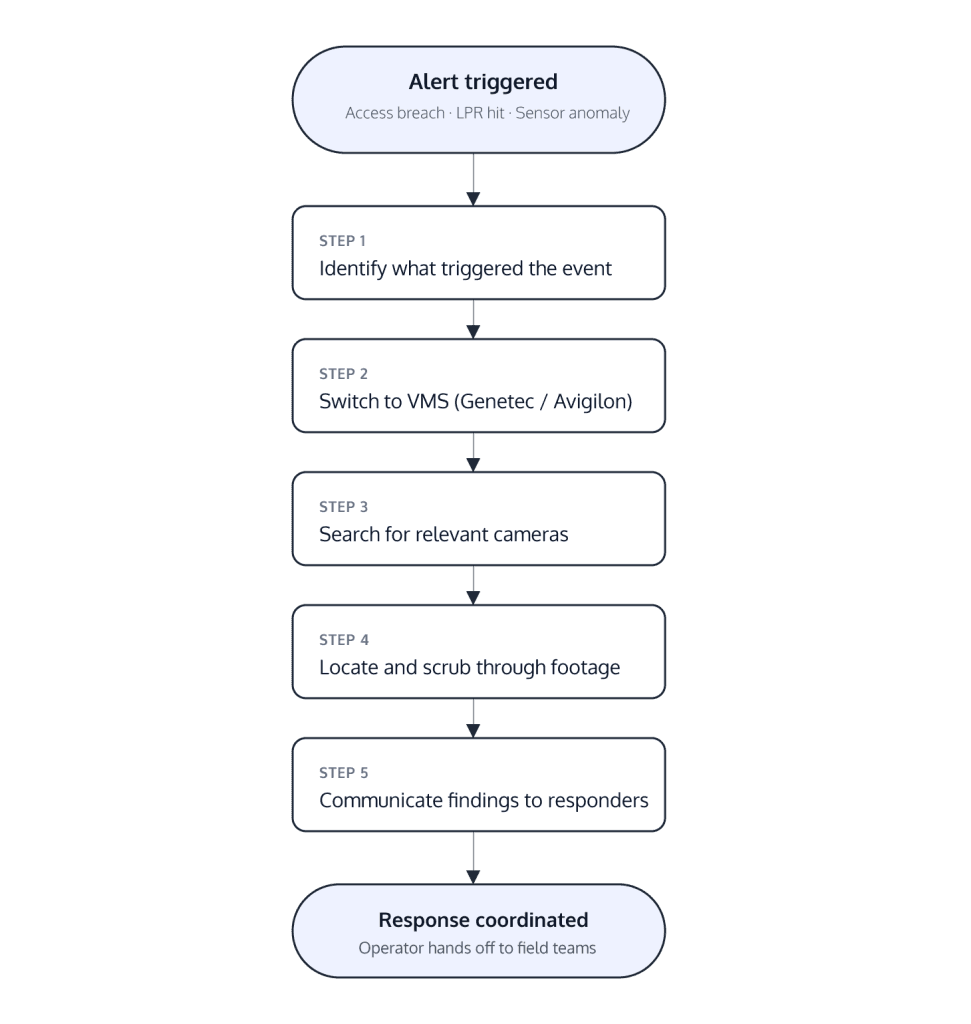
Consider a common scenario in a security operations center.
An alert is triggered. It could be an access-control breach, a license plate reader (LPR) hit, or a sensor anomaly.
The operator receives the alert and begins the process:
- Identify what triggered the event
- Switch to a video management system like Genetec or Avigilon
- Search for relevant cameras
- Locate and scrub through footage
- Communicate findings to responders
Each step is manageable on its own. But together, they introduce friction. Time is lost moving between systems. Context is fragmented. Operators are forced to interpret and assemble information under pressure.
The systems work, but only when someone stitches them together.
The Real Problem Isn’t Detection – It’s Coordination
Most modern security systems are highly effective at detection. Video analytics can identify movement and anomalies in real time. Access control systems track entry and exit across facilities. License plate recognition (LPR) systems capture vehicle data, and IoT sensors continuously monitor environmental conditions.
In many environments, detection is no longer the challenge. The challenge is what happens next.
Each of these systems generates alerts as designed. They surface events, flag anomalies, and provide visibility into what is happening across the environment. But they typically operate within their own domains, producing streams of information that must be interpreted and connected by human operators.
In practice, these systems run in parallel rather than as part of a coordinated response. An access control alert may indicate a breach; a video system provides visual context; and another system may contain additional operational data. Bringing these pieces together often requires manual effort, introducing delays at the exact moment when speed and clarity matter most.
This creates a critical gap between awareness and action.
Organizations can see what is happening, but translating that awareness into an immediate, coordinated response still depends on people navigating between systems, correlating data, and deciding what to do next. As environments become more complex and the volume of events increases, this gap becomes harder to manage and more consequential when incidents occur.
From Event to Action Without Manual Intervention
This is where Teldio Fabric changes the model. Using the same scenario, an alert is triggered, such as a door breach or a flagged vehicle.
Instead of relying on an operator to manually connect systems, Teldio Fabric handles the coordination automatically.
- The event is ingested in real time
- Relevant cameras are identified instantly
- Recent footage is bookmarked and made available
- Contextual data is pulled from connected systems
- Alerts are routed to the appropriate personnel
There is no need to switch between platforms. No need to manually search for information. No delay between detection and response. Before, operators had to interpret and coordinate. Now, they can receive and act.
Why This Matters in Security and Operations Environments
In active situations, events evolve quickly. Operators often manage multiple inputs simultaneously, balancing alerts from different systems while coordinating a response. Research shows that multitasking and frequent interruptions increase cognitive load, reducing situational awareness and slowing response times. Every additional step introduces risk:
- Delays in response
- Missed context
- Increased cognitive load
By removing manual coordination, organizations can:
- Reduce response times
- Improve situational awareness
- Lower operator workload
- Minimize the risk of missed or misinterpreted signals
Speed matters, but clarity determines the quality of the response.
From Information Systems to Operational Systems
This shift represents more than just automation. It changes the role of technology within the operations center.
Before: Detection → Manual coordination → Action
After: Detection → Automated coordination → Action
Instead of acting as isolated sources of information, systems become active participants in response. Teldio Fabric enables this transition by creating a layer that allows events to trigger coordinated, repeatable workflows across systems.
Expanding Automated Workflows Across the Environment
While the example above focuses on a single alert, the same approach applies across the entire environment. Any event can become a trigger for coordinated action, whether it originates from:
- Access control breaches
- Video analytics alerts
- Environmental and industrial sensors
- Asset tracking and geofencing
- AI-driven detections
As Brennan Turner, VP of Sales and Partnerships at Teldio, explains:
“A license plate recognition (LPR) hit is just one example. If a specific plate is detected, whether it’s a VIP arriving or someone who shouldn’t be on site, that event can automatically trigger other systems. You can notify staff, unlock doors, alert security over radio, or initiate any number of workflows. The key is that any logged event, camera analytics, facial recognition, or LPR can become a trigger. From there, you define the workflow and decide which systems or people need to respond.”
Each of these systems generates valuable information. Teldio Fabric ensures that information doesn’t remain isolated, but instead initiates workflows that connect systems and drive response.
Eliminating Manual Workflows at Scale
As organizations grow, so does the complexity of their environments. Multiple sites. Different vendors. Evolving infrastructure.
In these conditions, manual coordination doesn’t scale. Automating workflows across systems allows organizations to:
- Standardize response across locations
- Reduce reliance on individual expertise
- Improve operational consistency
- Build more resilient environments
The result is not just faster response times, but also more predictable and reliable outcomes.
The Future of Security and Operations Centers
Security and operations centers are becoming more complex. More systems are being deployed. More data is being generated. More decisions are being made in real time. In this environment, manual coordination becomes a bottleneck.
The next phase of evolution is not adding more tools; it’s ensuring those tools work together. Teldio Fabric creates a unified operational layer in which systems are no longer isolated but connected through logic, automation, and coordinated responses.
See Automated Response in Action
Want to see how this works in a real environment?
Want to see how Teldio Fabric eliminates manual workflows in security and operations centers? Book a demo to explore automated response across your environment.
See Teldio Fabric in Action - Book a demo!