

Air-Gapped Doesn’t Mean Disconnected: An Integration Architecture for Utilities, Pharma, and Finance
In regulated environments, isolation is often treated as protection. Utilities, pharmaceutical facilities, financial institutions, and critical infrastructure operators restrict internet access for good reasons: compliance, cybersecurity, operational risk, and audit control. The fewer unnecessary connections a critical environment has, the easier it is to manage exposure, document risk, and defend the network.
But isolation can create another problem. When security, communications, access control, alarms, video, and operational systems cannot share information, teams lose visibility at the exact moment coordination matters most. An access event may need to trigger a security response. An alarm may need to reach a radio user. A video event may need to be added to an incident record. If those systems cannot coordinate, the environment may be protected from external exposure while still creating internal blind spots.
That is the challenge facing many regulated organizations: how do you connect critical systems without weakening the boundary that protects them?
In reality, air-gapped environments can still support coordinated systems. Critical systems can operate within the approved security boundary, with controlled workflows, local execution, and audit-ready evidence.
What “Air-Gapped Integration” Actually Means
The phrase “air-gapped” can mean different things depending on the organization.
In practice, “air-gapped” is often used as shorthand for several different kinds of controlled environments. The exact architecture may vary, but the requirement is usually the same: critical systems must continue operating without relying on public internet access, public cloud availability, or uncontrolled data movement.
That distinction matters because not every restricted environment has the same architecture. A NERC-regulated utility, a pharmaceutical manufacturing site, and a financial services headquarters may all use different compliance language, but the underlying question is similar: can systems coordinate without creating unmanaged exposure?
The first step in evaluating any integration platform is to understand what level of isolation the environment actually requires.
A fully air-gapped environment may require no internet access and strict controls over software, updates, logs, and data movement. A segmented OT environment may separate operational systems from enterprise IT using firewalls, jump hosts, and access-control rules. A restricted on-prem environment may allow internal connectivity while avoiding dependency on public cloud services. A hybrid compliance environment may allow some outward connectivity while requiring critical workflows to run locally and produce evidence for audits.
In each case, the evaluation should start with practical questions:
Can the platform run without internet access? Can licensing be activated and maintained offline? Can the system produce audit logs and incident exports? Can it operate inside IT/OT boundaries? Can it pass a vulnerability scan or a third-party risk review? Can critical workflows continue if cloud access is unavailable?
Air-gapped integration allows systems to coordinate while preserving the security boundaries around them.
Why Regulated Environments Cannot Rely on Cloud-Dependent Workflows

Cloud platforms can be valuable, but not every environment can make cloud access part of a critical workflow.
In NERC-regulated utilities, pharmaceutical manufacturing, financial services, defense-adjacent operations, and other high-compliance environments, the question is not simply whether a cloud workflow is convenient. The question is whether it passes risk review, supports audit requirements, and keeps critical operations inside the approved network boundary.
Cloud dependency can create problems when a site has no internet access, outbound connections are prohibited, third-party systems are not allowed inside the environment, licensing requires online validation, audit evidence must remain local, or incident data must be exported through controlled procedures.
In those environments, “Can the system integrate?” is not enough.
The stronger question is: Can the system integrate without violating the architecture?
A platform that requires external connectivity to execute core workflows may be a poor fit for a regulated facility, even if it works well in less-restricted environments. For buyers in critical infrastructure, pharma, and finance, the architecture matters as much as the capability.
In regulated environments, an integration is only useful if it fits the compliance model it must live within.
Controlled Connectivity Is the Real Requirement
Regulated teams need integration, but unmanaged pathways, unclear dependencies, and audit risk can make a proposed architecture unacceptable.
Security and operations teams still need systems to coordinate. An alarm may need to trigger a radio alert. An access event may need to surface in a security workflow. A video event may need to be tied to an incident record. A facility event may need to generate a response without waiting for manual handoffs.
Teams need to understand how systems communicate, where the logic runs, and what evidence the workflow produces.
Controlled connectivity requires known systems, known protocols, known network paths, local workflow execution, clear access controls, audit logging, exportable incident records, and no hidden cloud dependency.
The goal is accountable connectivity: every connection should be controlled, visible, and reviewable.
A regulated integration architecture should make system behavior visible, controlled, and reviewable.
What the Integration Layer Actually Does Inside the Boundary
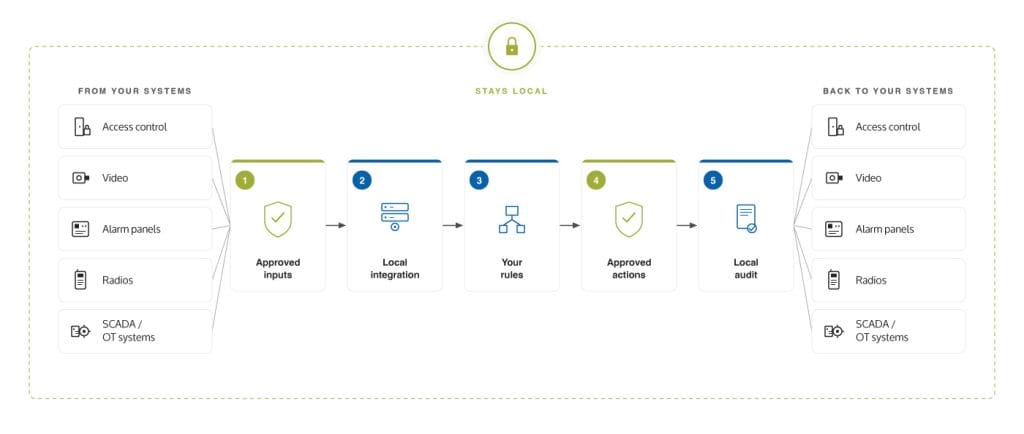 An integration layer should sit inside the approved architecture, where it can receive events from trusted internal systems, apply rules, trigger actions, and log the result for review without opening unnecessary pathways.
In practical terms, the workflow looks like this:
An event enters from an approved internal system. The integration layer receives the event locally. Rules determine what should happen next. Connected systems receive the appropriate action. The event and response are logged. Incident data can be exported for review when required.
That architecture can connect systems such as access control, video, alarm panels, radio systems, SCADA or OT systems, building systems, security operations tools, and incident response platforms without making each system externally reachable.
This is where Teldio Fabric fits into the conversation.
Teldio Fabric is positioned as a software-defined integration layer for environments that need connected workflows without forcing cloud dependency. It can support physical security, communications, alarms, video, and operational workflows within the customer’s architecture.
The architecture should match the customer’s security model. For some organizations, that may mean an on-prem deployment. For others, it may mean running in a virtual machine within existing infrastructure. In some cases, a private or customer-controlled environment may be acceptable, depending on compliance requirements.
The important principle is simple: bridge approved internal systems without unnecessarily exposing the environment.
The integration layer enables regulated systems to coordinate without violating the boundary that protects them.
Licensing, Updates, and Support in Offline Environments
In air-gapped or internet-limited environments, licensing and maintenance are not minor details. They are part of the architecture review.
A platform may function well in a connected environment but create friction in a restricted one if it needs to phone home, validate online, pull updates directly, or connect to a cloud service to operate.
That creates practical questions early in the buying process.
Can licensing be activated offline? How are renewals handled? How are updates packaged, reviewed, and applied? Can the support operate without direct remote access? How are logs collected for troubleshooting? What happens when the system cannot reach the vendor?
Offline licensing matters because compliance teams do not want critical systems dependent on external validation paths. Controlled updates matter because software may need to be scanned, approved, staged, and installed in accordance with internal change-management procedures. Support without uncontrolled remote access matters because some organizations cannot allow a vendor to connect directly into the environment.
For regulated customers, a complete deployment includes licensing, updates, and support procedures that fit the control model.
Audit Trails Are Not a Nice-to-Have
In regulated environments, integration must coordinate systems and preserve evidence of what happened after the fact.
Security, compliance, and operations teams may need to show when an event occurred, which systems were involved, what action was triggered, whether the workflow completed, and what data was exported for review.
An audit-ready workflow should capture the event source, timestamp, trigger condition, workflow action, system response, user acknowledgment, exported incident data, and any failure or exception state.
These records make an integration audit-ready.
In addition to triggering actions, an audit-ready integration records what happened throughout the workflow.
This matters for regulatory reviews, third-party audits, after-action reviews, investigations, and internal improvement. If an incident occurs, teams should not have to reconstruct the timeline from disconnected systems manually. The architecture should make evidence collection controlled and repeatable.
If the workflow cannot be reconstructed later, it is not audit-ready.
Security Scanning and Risk Review Should Be Expected
Regulated buyers evaluate whether the software works and can withstand formal review.
That may include vulnerability scanning, third-party risk assessments, architecture review, firewall review, software inventory, and documentation of how data moves through the environment. Integration platforms should be prepared for this level of scrutiny.
For any IT/OT or cybersecurity stakeholder, the questions are specific. What ports are used? Which systems connect? What data is exchanged? Does anything leave the environment? How are updates handled? What documentation exists for change control? What happens if remote support is not allowed?
These questions are a standard part of the buying process in regulated markets.
In high-compliance environments, passing technical review is part of the product value.
A Worked Example: A NERC-Regulated Utility Environment
Consider a NERC-regulated utility or ISO environment.
The organization needs to coordinate security and operational workflows while protecting the boundaries around critical infrastructure. The environment may have segmented networks, strict access rules, no dependence on public internet for core operations, and annual audit requirements.
In that environment, an internal alarm event occurs. Fabric receives the event inside the controlled environment. The workflow applies logic based on site, severity, and system type. A notification is routed to the approved internal communication channel. The event is logged locally. If required, incident data can be exported through an approved process.
The utility retains its restrictions while gaining better coordination inside the controlled environment.
The same pattern can apply across access control, video, alarms, radios, OT-adjacent systems, and incident records. The integration layer gives teams a controlled way to move critical information while preserving the boundary.
Why the Same Architecture Matters in Pharma and Finance
 The verticals differ, but the concern is similar.
Pharmaceutical facilities may require strict validation, controlled change management, facility security, and auditable evidence of incidents. Financial institutions may need third-party risk review, controlled system access, reliable incident data, and clear security operations workflows. Critical infrastructure operators may focus on segmentation, resilience, local execution, and regulator-ready evidence.
In each case, the integration platform must respect the environment.
Air-gapped and on-prem security integration is an architecture choice for organizations that need connected systems, controlled data movement, and defensible audit trails.
The compliance language changes by industry, but the integration problem is the same: connect systems without creating unmanaged exposure.
Questions to Ask Any Integration Vendor Before You Sign
For regulated teams, the vendor conversation should clarify the architecture rather than ask compliance teams to accept assumptions.
Before choosing an integration platform, clients should ask:
- Can your platform operate without internet access?
- Look for a clear explanation of local execution, offline licensing, update procedures, and which functions, if any, require external connectivity.
- Where does the integration logic run?
- The vendor should be able to identify whether logic runs on-prem, in a VM, in a private environment, or in a vendor cloud.
- What data leaves the environment?
- A strong answer should be specific about event data, logs, telemetry, support access, and exports.
- Can the system produce audit-ready incident records?
- Ask whether records include timestamps, event sources, actions, outcomes, acknowledgments, and export options.
- How does support work if remote access is not allowed?
- The vendor should explain approved troubleshooting methods, log exports, customer-mediated support, and escalation procedures.
- Has the platform been reviewed in regulated environments before?
- Look for experience with vulnerability scanning, risk assessments, controlled deployments, or regulated customer requirements.
The right vendor conversation should clarify the architecture.
The Buyer’s Question That Matters
The right question is not: “Can this platform connect our systems?”
The better question is: “Can this platform connect our systems inside our security boundary, operate without cloud dependency, and prove what happened after the fact?”
If the answer is uncertain, that is the work.
Regulated organizations need integration that fits and preserves their control model.
Air-gapped does not have to mean disconnected. It should mean connected with discipline, control, and evidence.
Talk to Teldio About Air-Gapped Security Integration
Teldio Fabric helps regulated organizations connect physical security, communications, alarm, video, and operational systems inside controlled environments.
If your environment has strict boundaries, Teldio can help design workflows that respect them while providing your teams with the coordination and audit visibility they need.
Speak with Teldio about building audit-ready security integrations for air-gapped and regulated environments.